Why Silence Is One of the Most Powerful Tools in Radio

When people think about great radio, they usually think about music, presenters or audio processing. Rarely does anyone mention silence. That’s understandable, because dead air has always been every broadcaster’s nightmare. If the transmitter goes quiet unexpectedly, phones start ringing within minutes.

But there’s a big difference between dead air and intentional silence.

Some of the best radio I’ve ever heard wasn’t defined by what happened during a song or a speech. It was defined by what happened just before it.

We’ve become afraid of silence

Over the years, radio has become increasingly dense. Songs are processed to sound louder, presenters are encouraged to keep talking, sweepers are everywhere and production often fills every available millisecond. Somewhere along the way, we started treating silence as something that needed fixing.

I think that’s a mistake.

Our brains don’t only notice sound. They notice contrast. A brief pause before an emotional story or a perfectly timed second of silence after a powerful sentence can have far more impact than another loud sound effect or whoosh.

It’s the same reason a great comedian knows exactly when not to speak.

Music already understands this

Listen carefully to some of the greatest songs ever recorded. Many of them use silence as an instrument. A short pause before the chorus makes the chorus explode with energy. A break before the final note creates tension. Even in heavily produced pop music, those tiny moments of emptiness are carefully designed.

Yet in radio production, we often remove every gap because we’re afraid someone might think something has gone wrong.

Sometimes, leaving that tiny space untouched creates a much stronger emotional response.

Less processing can reveal more

The same principle applies to audio processing.

I occasionally hear stations where every transient has been flattened, every quiet moment lifted and every dynamic squeezed out of the music. The result is impressive for about five minutes. After that, everything starts sounding equally important.

If everything is loud, nothing stands out.

Dynamics are what give music emotion. They’re also what make speech sound natural. Preserving a little space in the audio often creates a richer listening experience than simply pushing for more loudness.

Give your presenters room to breathe

One of my favourite presenters once told me that listeners aren’t afraid of silence.

Presenters are. – He was right.

New presenters often rush to fill every gap because silence feels uncomfortable from behind the microphone. Experienced presenters know that a well-timed pause can add suspense, emphasize a point or simply give listeners a moment to absorb what was just said. That’s confidence. Not hesitation.

Radio isn’t a race

Technology has given us incredible tools. We can automate stations, process audio with remarkable precision and distribute streams across the globe in seconds. None of that means we need to fill every available moment with sound.

Sometimes the most memorable moments happen in the space between them.

Final thoughts

The next time you’re editing a promo, producing an imaging piece or fine-tuning your processing, resist the temptation to fill every gap. Listen to what happens when you leave just a little room for the audio to breathe.

You might discover that silence isn’t the absence of sound.

It’s part of the performance.

Whether you’re fine-tuning your station’s processing, producing imaging or looking for ways to make your audio more engaging, I’d be happy to help. Sometimes the smallest adjustments make the biggest impact.

What Broadcasters Can Learn from Music Streaming Services

For years, broadcasters have viewed music streaming services as the competition. Every new Spotify feature or Apple Music announcement seems to spark another discussion about whether radio is slowly losing relevance. Personally, I think we’re asking the wrong question. Instead of worrying about what streaming services are doing better, we should be asking ourselves what they’re doing differently, and whether there’s something worth learning from it.

The obvious answer is that streaming platforms have changed listener expectations. People have become accustomed to opening an app and hearing music within seconds. Everything feels effortless. Album artwork loads instantly, metadata is always accurate, playlists continue seamlessly across devices, and the entire experience has been designed to disappear into the background. You simply press play and enjoy the music.

Now compare that to the average radio station. The stream may take several seconds to start, the artwork is missing, the title still displays the previous song and the mobile app feels like it hasn’t been updated in years. None of those things have anything to do with the quality of the presenters or the music programming, yet they shape the listener’s perception of your station before the first song has even finished.

This is something the streaming companies understand exceptionally well. User experience isn’t an extra feature. It is the product.

That doesn’t mean radio should try to become Spotify, because that’s a battle it simply cannot win. Spotify has more songs than any radio station could ever play, sophisticated recommendation algorithms and billions of dollars invested in its platform. Competing on catalogue size or personal playlists would be pointless.

Fortunately, radio has something Spotify doesn’t.

Radio creates moments.

Nobody opens Spotify expecting to hear a presenter reacting to breaking news that happened five minutes ago. Nobody expects an algorithm to capture the atmosphere of a local festival or make them smile with an unexpected joke during the morning commute. Live radio creates shared experiences, and that’s something no recommendation engine has managed to replicate.

Ironically, even Spotify seems to realise this. Over the past few years we’ve seen the introduction of AI DJs, editorial playlists, human-curated recommendations and personalised radio stations. In many ways, streaming services have started borrowing ideas from traditional broadcasting instead of replacing them.

Where broadcasters can really learn from streaming services is in the details. Metadata should always be correct. Album artwork should never be missing. Mobile apps should feel modern instead of functional. Streams should start quickly and remain stable. None of these improvements require changing your format or hiring more presenters. They simply show respect for the listener’s time.

Another lesson is the way streaming platforms use data. Some broadcasters become nervous as soon as analytics enter the conversation, fearing that creativity will be replaced by algorithms. I don’t see it that way. Data should never dictate your programming decisions, but it can certainly help you understand your audience better. If listeners consistently leave the stream at a particular moment or certain devices experience buffering problems, that’s valuable information. Ignoring it doesn’t make you more creative; it simply means you’re flying blind.

Perhaps the biggest lesson is that streaming companies obsess over consistency. Every interaction has been carefully considered. Whether someone is listening on a phone, laptop, smart speaker or in the car, the experience feels familiar. Radio stations often focus heavily on audio quality, investing in excellent studios, microphones and processing, while overlooking the digital experience surrounding the stream. Yet for many listeners, the app, website or smart speaker integration is every bit as important as the station itself.

In the end, I don’t think broadcasters should fear Spotify or Apple Music. If anything, they should study them. Not because radio needs to imitate streaming services, but because those platforms have become incredibly good at removing friction. They make listening easy, and that’s a lesson every broadcaster can benefit from.

Radio still has one enormous advantage: it is created by people, for people, in real time. Technology should support that experience, not get in the way of it.

If you’re looking to modernise your station, whether that’s improving your stream quality, metadata, processing or the overall listener experience, feel free to get in touch. I’d be happy to help you make your station sound and feel as good online as it does on-air.

Why Your Station Needs Different Processing for FM, DAB+ and Streaming

There’s one question I hear surprisingly often.

“Can I just use the same processing chain for FM, DAB+ and my online stream?”

Technically? Absolutely.

Should you? Never.

Each distribution platform has its own strengths, limitations and listening environment. Yet many broadcasters still feed every platform from a single processor preset. It’s easy, but it’s rarely the best choice.

FM is still its own beast

FM broadcasting has been around for decades, and the processing philosophy has evolved alongside it. You’re dealing with pre-emphasis, modulation limits, multipath reception and receivers ranging from €20 clock radios to high-end car stereos. FM processing needs to sound exciting while staying within strict technical boundaries.

It’s a balancing act.

DAB+ gives you more freedom… and new challenges

Unlike FM, DAB+ doesn’t have modulation limits in the same way. Instead, you’re dealing with perceptual audio codecs. If your processing is overly aggressive, the codec has a much harder time doing its job. Heavy clipping, excessive high frequencies and dense audio can actually introduce more audible artifacts after encoding. Sometimes, less processing results in better sounding DAB+ audio.

That still surprises people.

Streaming changes everything

Online streaming is the least predictable platform of them all.

Your listener could be using:

  • AirPods
  • A Bluetooth speaker
  • A smartphone
  • Smart TV speakers
  • A connected car
  • Studio headphones

Every device colors your audio differently. Unlike FM, you don’t know what the playback system will look like. That’s why many successful online stations use slightly more open processing with fewer clipped peaks and more natural dynamics. The stream simply breathes more.

One station. Three signatures.

Your station should sound recognizable everywhere. That doesn’t mean it should sound identical everywhere. Think of it like photography. The same picture might need different editing for print, Instagram and a billboard. The image stays the same. The presentation changes.

Audio works exactly the same way.

Don’t forget your listeners

Many broadcasters optimize processing while sitting in front of expensive studio monitors. That’s important. But your listeners aren’t.

They’re driving to work. Cooking dinner. Walking the dog. Listening through €30 earbuds.

Test your station where your audience actually listens. You’ll discover far more than any spectrum analyzer can tell you.

Final thoughts

Processing isn’t about creating one perfect preset. It’s about creating the best experience for every platform. FM. DAB+. Streaming. They each deserve their own personality while still sounding unmistakably like your station.

Looking to optimize your station for every platform? Whether you’re broadcasting on FM, DAB+ or online, I’d be happy to help you create processing that gets the very best out of each distribution channel.

Why AI Will Never Replace a Good Audio Processor

Artificial Intelligence is everywhere. It writes scripts. Generates voices. Schedules music. Even edits podcasts.

So it’s only natural that people ask me the same question.

“Will AI replace audio processing?”

My answer? No. At least, not in the way most people think.

AI is becoming a fantastic assistant

Modern AI can already detect speech, remove background noise, separate instruments and even suggest processing settings. That’s impressive. It can save engineers hours of work. But there’s one thing AI still struggles with.

Taste.

Every station has a personality

Imagine asking AI to create “the perfect radio sound.”

Perfect for whom?

A rock station? A jazz station? A dance station? A news station?

There isn’t one correct answer. Audio processing is branding.

The way your station sounds tells listeners what to expect before a single presenter even opens the microphone. That’s not mathematics.

That’s emotion.

Context matters

Should the morning show sound slightly more energetic? Should commercials be controlled differently? Should overnight programming breathe more?

These decisions aren’t made by algorithms alone.
They’re made by understanding your audience.

AI will make engineers better

The exciting part isn’t replacing engineers. It’s giving them better tools. Imagine software that continuously analyzes listener devices, predicts codec artifacts, or suggests improvements based on real-world playback.

That future isn’t far away.

AI-assisted workflows are already becoming part of professional broadcast environments.  But someone still has to decide what “good” actually sounds like.

The human factor

Some of my favorite processors don’t win laboratory measurements.

They simply sound… right.

Warm. Open. Punchy. Relaxed.

Those aren’t technical specifications. They’re emotional reactions.

And that’s exactly why processing remains as much an art as it is engineering.

Final thoughts

AI will absolutely change broadcasting. It already is. But I don’t believe listeners will ever fall in love with an algorithm.

They’ll fall in love with stations that sound authentic.

Technology helps.

Taste decides.

Looking to modernize your audio chain without losing your station’s unique sound? Feel free to get in touch. I’d love to help you combine the latest technology with processing that truly fits your brand.

Why Your Radio Stream Sounds Different on Every Device

Have you ever noticed that your radio station sounds fantastic in the studio, but completely different on a phone, smart speaker or car stereo?

You’re not imagining it.

Many broadcasters spend weeks perfecting their FM processing, yet the online stream is often treated as an afterthought. The result? A station that loses its identity the moment listeners switch to streaming.

Streaming is a different world

FM transmission has physical limitations and characteristics that engineers have worked around for decades. Streaming doesn’t.

Instead, your audio is decoded by countless devices, each with its own DAC, speaker configuration and loudness behavior. Add Bluetooth speakers, AirPods, Android phones, iPhones, smart TVs and connected cars to the mix, and suddenly your carefully crafted sound becomes unpredictable. That’s why simply copying your FM processor settings to your stream is rarely the right solution.

More loudness isn’t always better

One of the biggest misconceptions is that online radio should be as loud as possible. Sure, a loud station grabs attention for a few seconds. But excessive multiband compression and clipping quickly lead to listener fatigue. People don’t necessarily notice why they’re tuning away, they just do.

Good processing creates consistency. Great processing creates emotion.
There’s a huge difference.

Think about your audience

A dance station can get away with a more aggressive sound than a classical music station. A station targeting office workers during the day probably needs a completely different processing philosophy than a CHR station aimed at teenagers. The processor shouldn’t only match your music. It should match your brand.

Test on real devices

This is something I always recommend: Don’t judge your sound through expensive studio monitors alone.

Listen on:

  • Car speakers
  • Cheap Bluetooth speakers
  • Smartphones
  • Earbuds
  • Smart speakers
  • Laptops

You’ll quickly discover problems that were completely hidden inside the studio.

Small changes can make a huge difference

Sometimes a tiny EQ adjustment or slightly less clipping makes the stream sound dramatically more open without sacrificing competitive loudness. Processing isn’t about making every meter hit the red.

It’s about making people want to keep listening.

Final thoughts

Your online stream is often the first impression new listeners get of your station. If it sounds harsh, flat or tiring, they may never come back. Take the time to optimize your streaming chain separately from your FM chain. Your listeners will notice, even if they can’t explain why.

Need help getting the best possible sound from your FM, DAB+ or online stream? Feel free to get in touch. I’d be happy to help your station develop a signature sound that listeners instantly recognize.

Streaming is not FM-Radio!

Listening to radio has changed over the couple of years. More and more listeners are grabbing their phones to listen to radio instead of listening to traditional FM-Radio. As a Program Director for my online radio station and Sound Consultant for several radio stations, I’m getting quite annoyed when listening to online radio nowadays. Let’s dig in some online processing!

“Your online streaming encoder should never be clipped. It destroys all details in the decoded audio afterwards.”

Processing for streaming audio is completely different than processing for FM. Unfortunately, many radio stations fail to know just how different it is. Unlike FM-Radio – where loudness is realised with clipping the audio – the input to a online streaming encoder should never be clipped. It’ll destroy all details in the decoded audio afterwards.

Lossy encoders (like MP3, AAC and HE-AAC(v2)) perform at their best when the incoming audio has short-term dynamics, also known as “peaks”. This is where the encoder attempts to cover or hide any audible encoding artefacts. When the input audio lacks these short-term dynamics, the artefacts are more revealed and audible for your audience.

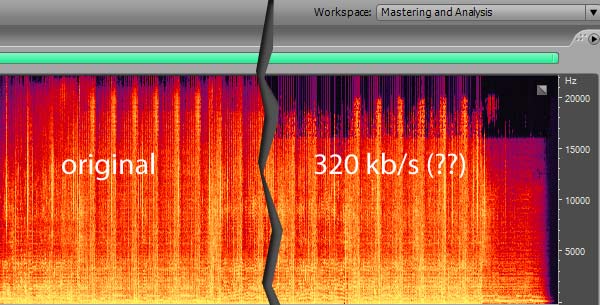
Horrible artefacts on a well-processed original audio file. (WAV vs. MP3)

In this example image you see a processed audio file (through an (radio) audio processor) on the left (WAV: 16bit/48KHz), and on the right the same segment after MP3 encoding (320kbps / Online streaming). As you notice: a lot of details are missing after encoding the compressed/processed audio. I’m still surprised with stations still using MP2 384kbps – or even MP3 320kbps Audio Files in their audio vault, but that’s a topic I’ll cover in a next blog.

Deliver a product that is loud enough and more enjoyable to listen to than FM radio.

With all processing, increased loudness will come with a large drop in openness and quality. Depending upon the market, it it sometimes necessary for an FM station to walk on that line to stay competitive loud against other radio stations in the market. Thankfully it is possible to deliver HD Audio through streaming: deliver a product that is loud enough and significantly more enjoyable to listen to than FM radio.

I’m not suggesting that you feed a quiet stream. Really: I’m not. But unlike FM radio listeners who are able to quickly punch up stations with presets on their car radio, changing streams requires more time. By the time the new stream buffers and loads, any comparative loudness opportunities have been lost.

There is really no need to be loud and having a ‘flat waveform’ online.

Apart from the fact that it sounds horrible after being encoded and played at (for example) AirPods or small speakers, it isn’t necessary. Let your audience enjoy online audio again, with great processing that’s adding value to your audio instead of clipping your audio with evil effects at the end.

An advice for streamers: Stay away from the -0.0dB Peak Output Level

A great advice for you online streamers: stay away from a -0.1dB peak level on your streams. After encoding there will be some added peaks due to encoding. A optimal level for streaming is always -3dB peak. This way you have enough headroom for the encoder (and decoder afterwards) to handle peaks. If you peak your encoder at a digital 0dB or even -0.1dB peak level, it’ll have digital distortion afterwards.

Send me an e-mail at [email protected] with your own audio-stream, and let’s get in touch about your online processing.